



Maximo | Interloc Solutions | EAM | asset management | Maintenance | IBM MAS | Maximo Application Suite (MAS) | Enterprise asset management (EAM) | IBM Maximo Application Suite | Agentic AI
I've worked with IBM Maximo since 2001, and although the technology has changed considerably, many maintenance challenges haven't. Across industries, I still see organizations struggling with preventive maintenance (PM) backlogs, limited resources, and unexpected failures.
Most organizations understand that a strong PM program can reduce corrective and emergency work. Keeping up with it is another matter. In my experience, highly regulated organizations tend to have more consistent PM compliance, while others often struggle to stay on schedule.
That's why the evolution of IBM Maximo Application Suite (MAS) interests me. It offers new ways to tackle familiar problems, including opportunities introduced with agentic AI in MAS 9.2.
The Value of Getting the Fundamentals Right
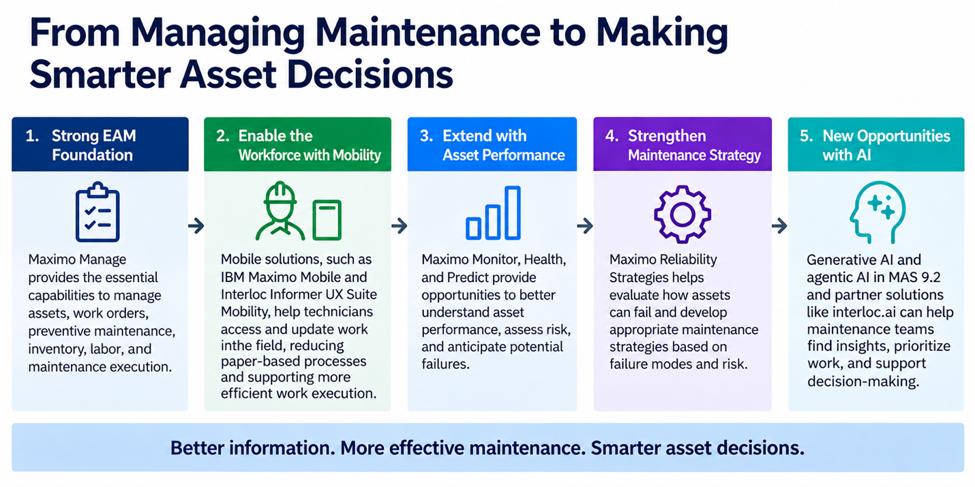
Before looking at newer technologies, I always come back to the fundamentals. Maximo Manage provides the core Enterprise Asset Management (EAM) capabilities for assets, work orders, PMs, inventory, and labor. Getting those basics right can deliver significant value.
In one customer engagement, implementing Maximo, improving work processes, and introducing mobility helped improve maintenance response times, streamline execution, and reduce administration. Interloc's Informer Mobility solution let technicians access and update work information in the field, reducing reliance on paper. We also saw better management of maintenance resources and materials.
What stood out was that none of this required predictive analytics or AI. The gains came from effective EAM, practical mobility, and better processes. It's a reminder I often share with customers: don't underestimate the fundamentals.
Moving Beyond Traditional EAM
MAS builds on that foundation. Maximo Monitor and Health arrived in the early MAS 8.x releases, before MAS 9.2, and have continued to evolve alongside Predict. These Asset Performance Management (APM) applications help organizations understand asset performance, assess condition and risk, and anticipate failures.
But availability doesn't guarantee value. I generally recommend a focused pilot using an organization's own asset data before committing to a broad APM rollout. It can help assess results and potential return on investment (ROI). Tools such as the Interloc APM Accelerator Kit can support that evaluation. For a pilot, I would focus on assets with a clear business problem, check that the necessary data is available, and agree on success measures such as asset availability, unplanned maintenance, or maintenance cost before starting.
IBM introduced Maximo Reliability Strategies in the later MAS 8.x releases, bringing an industry-informed library of failure modes and mitigation activities into the suite. It helps organizations assess how assets can fail, consider the consequences, and develop maintenance strategies to address those risks.
I've seen organizations work hard to complete their PM schedules, but the more important question is whether every PM is still appropriate and resources are focused on the assets that need them most.
It's not necessarily about doing more maintenance. It's about doing the right maintenance.
AI Introduces Another Opportunity
IBM introduced the generative AI-powered Maximo Assistant with MAS 9.1. In MAS 9.2, IBM expanded its agentic capabilities to coordinate tools and support multistep tasks. The ability to extend functionality through tools is particularly interesting and deserves further exploration as organizations identify practical use cases.
My involvement in developing our agentic AI solution, interloc.ai, has given me a firsthand view of how AI can complement Maximo. The potential goes beyond answering questions.
Consider a supervisor facing hundreds of open work orders and constantly changing priorities. An AI assistant could potentially help review the backlog using asset criticality, work priority, and maintenance history to identify work that deserves attention.
That would require appropriate data, tools, permissions, and business rules. AI should support the supervisor's judgment, not replace it or bypass established Maximo processes.
When customers ask where to begin, I suggest understanding their AI governance policies and choosing a genuine business problem. Not everything needs AI. Traditional automation is often the better answer for predictable processes. Reliable data, appropriate access controls, and clearly defined business processes are also important prerequisites.
My Perspective After 25 Years with Maximo
After 25 years with Maximo, I still see the same pressures: backlogs, limited resources, and unexpected failures. What has changed is the range of tools available to address them.
I've seen how much value good EAM practices and mobility can deliver on their own. I'm also encouraged by IBM's continued evolution of MAS, from APM and Reliability Strategies to agentic AI in MAS 9.2, along with opportunities for partner solutions such as interloc.ai to complement and extend these capabilities.
I'll explore more of these capabilities in future articles. For now, my advice is simple. Start with the business problem, evaluate the options, and adopt what delivers meaningful value. A practical phased approach is to strengthen the EAM foundation, test selected APM, reliability, or AI use cases, measure results, and expand what works.
To me, the opportunity is to move beyond managing maintenance efficiently and use better information to make smarter asset decisions.