


Maximo | Interloc Solutions | Reliability | Maximo Monitor | APM | IBM MAS | Maximo Application Suite (MAS) | IBM Maximo Application Suite
Moving Beyond Traditional Maintenance Management
IBM Maximo has long helped organizations manage assets, schedule preventive maintenance, and maintain equipment histories. While these capabilities remain essential, they raise an important question:
Are we making the best possible use of the information we already have about our assets?
Traditional maintenance practices provide a strong foundation but may not reveal early signs of equipment deterioration or whether existing maintenance activities adequately address failure risks.
Asset Performance Management (APM) builds on these practices by combining maintenance history, asset condition data, and reliability knowledge to support better decisions.
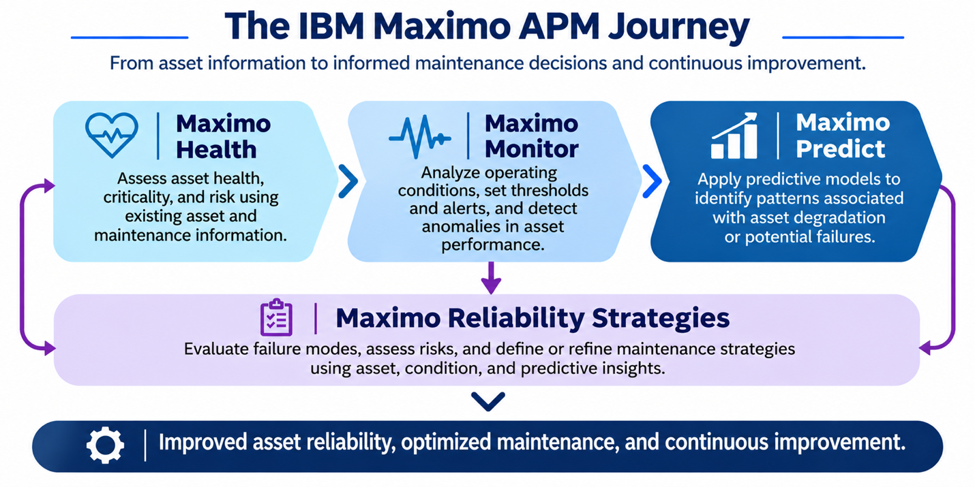
IBM Maximo Health, Monitor, and Predict offer a practical progression toward understanding asset performance. IBM Maximo Reliability Strategies complements these capabilities by helping organizations evaluate failure modes and develop appropriate maintenance approaches.
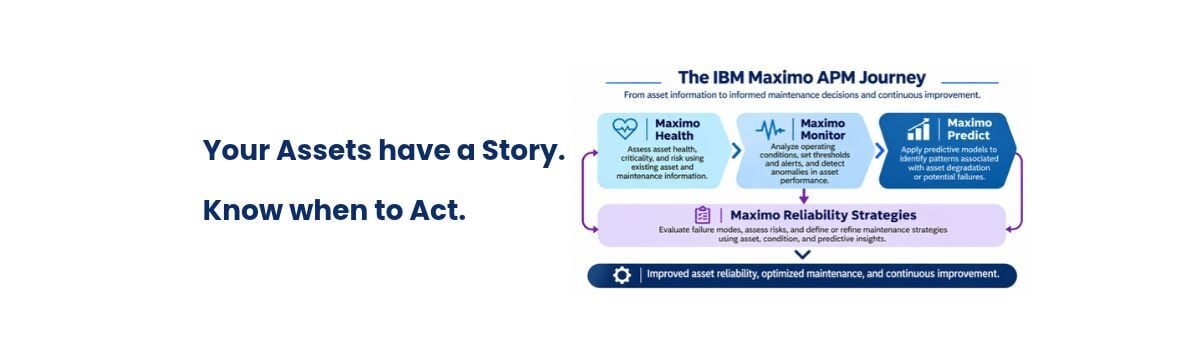
The following infographic illustrates this journey. It represents a suggested approach rather than a required implementation sequence.
Start With Business Value, Not Technology
One lesson from working with organizations exploring APM is that the starting point should be the business problem, not the technology.
Consider a manufacturing environment where unexpected failures affect a critical production asset. The priority is understanding those failures and reducing their operational impact, rather than simply collecting more sensor data.
For example, if lost production represents $25,000 per hour, avoiding four hours of downtime could deliver $100,000 in potential value. While hypothetical, this illustrates the importance of selecting the right assets.
Organizations should prioritize critical assets while considering maintenance history, data availability, and the feasibility of obtaining meaningful insights.
The objective is to identify where better asset information can deliver measurable business value.
Making Better Use of Maintenance History
Most Maximo environments already contain valuable information in work orders, failure reports, preventive maintenance records, and asset histories.
However, this information was often collected to support maintenance execution rather than advanced analysis. A work order may identify a motor failure without capturing precisely when deterioration began or the conditions that contributed to it.
Even imperfect historical data can reveal recurring problems, failure frequency, and assets requiring attention. When sensor readings are available, organizations can compare them with historical failures to identify potential relationships.
Where history is limited, information from similar equipment may provide a starting point, provided operating conditions and equipment differences are considered.
Organizations do not need perfect data to begin improving their understanding of asset performance.
Starting With Maximo Health and Reliability Strategies
IBM Maximo Health provides a practical starting point by using existing asset and maintenance information to assess health, criticality, and risk. Organizations can begin without sensor integration and incorporate additional condition data as their capabilities mature.
Maintenance history, asset age, and failure frequency can help identify assets needing greater attention.
IBM Maximo Reliability Strategies helps organizations evaluate failure modes and identify maintenance activities intended to mitigate associated risks using existing asset knowledge and reliability engineering practices. It can do so independently of Monitor or Predict.
Together, these capabilities help answer two important questions: Which assets deserve attention, and are we performing the appropriate maintenance activities to address their failure risks?
Introducing Maximo Monitor
While maintenance history explains what has happened, IBM Maximo Monitor provides visibility into equipment operating conditions.
For rotating equipment such as motors, measurements may include vibration, temperature, electrical current, and other relevant parameters.
For example, where repeated motor failures are documented in Maximo Manage, organizations can compare available historical sensor readings with failure events to investigate whether changes in vibration or temperature preceded those failures.
The objective is not simply collecting data, but identifying conditions that warrant investigation before equipment fails.
Establishing Thresholds and Identifying Anomalies
A key challenge in condition monitoring is determining when operating conditions should trigger attention.
Where historical failures and corresponding sensor readings are available, organizations can analyze these relationships to establish initial monitoring thresholds.
When history is insufficient, manufacturer recommendations, engineering knowledge, and operating baselines can provide a starting point. Thresholds can then be refined as additional information becomes available.
Anomaly detection offers another perspective. Equipment may exhibit unusual behavior without exceeding established thresholds. These deviations may warrant investigation, although they do not necessarily indicate impending failure.
The greatest value comes from combining historical information, operating conditions, and engineering judgment.
Advancing to Maximo Predict
As organizations develop suitable historical and operational datasets, IBM Maximo Predict can apply predictive models to identify patterns associated with asset degradation or potential failures. The data required depends on the analytical approach and prediction model.
This extends monitoring beyond recognizing unusual conditions toward evaluating patterns that may indicate increased failure risk.
However, meaningful predictive insights depend on data quality, availability, and relevance. Not every asset will have sufficient information to support predictive models.
Where appropriate, these insights can also inform reliability planning by helping organizations reassess failure risks and maintenance approaches.
Predictive analytics complements reliability engineering rather than replacing it.
Building Confidence Before Changing Maintenance Strategies
Introducing APM does not mean organizations should immediately change preventive maintenance programs.
The first priority is validating the information. Are sensor readings reliable? Do alerts reflect meaningful conditions? Can maintenance teams explain and act on the insights?
IBM Maximo Reliability Strategies provides a structured approach to evaluating failure modes, risks, and mitigation activities before making maintenance strategy changes.
For example, an organization relying on time-based motor inspections may eventually determine that some activities can be supplemented with condition-based monitoring. Such decisions should follow validation of operating data and consideration of equipment criticality and failure consequences.
The goal is not to eliminate preventive maintenance, but to ensure maintenance activities remain appropriate for the risks they address.
APM Is a Journey of Continuous Improvement
Organizations do not need to implement every APM capability at once.
Some may begin with Health to understand asset condition and criticality. Others may introduce Monitor to gain operational visibility or Predict where sufficient data supports predictive analysis.
In our experience working with organizations exploring APM, the most effective approach is to build progressively, validate insights, and expand capabilities as confidence grows.
The real value of APM is not simply collecting more information about our assets. It is understanding what that information tells us, recognizing when something deserves attention, and knowing when to act.